

 |
Influence of playing site and weekly training frequency on physical performance in elite padel players González-Jiménez, A., Muñoz, D., Castaño-Zambudio, A., Sánchez-Alcaraz, B.J., & Martín-Miguel I. Journal of Functional Morphology and Kinesiology, 11(2), 111. https://doi.org/10.3390/jfmk110111. Año 2026 |
 |
Resumen:
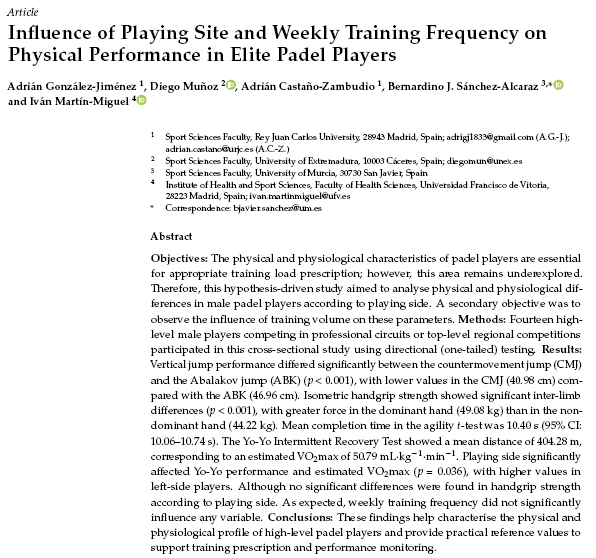
Objectives: The physical and physiological characteristics of padel players are essential for appropriate training load prescription; however, this area remains underexplored. Therefore, this hypotesis-driven study aimed to analyse physical and physiological differences in male padel players according to playing side. A secondary objective was to observe the influence of training volume on these parameters. Methods: Fourteen high-level male players competing in professional circuits or top-level regional competitions participated in this cross-sectional study using directional (one-tailed) testing. Results: Vertical jump performance differed significantly between the countermovement jump (CMJ) and the Abalakov jump (ABK) (p<0.001), with lower values in the CMJ (40.98 cm) compared with the ABK (46.96 cm). Isometric handgrip strength showed significant inter-limb differences (p<0.001), with greater force in the dominant hand (49.08 kg) than in the non-dominant hand (44.22 kg). Mean completion time in the agility T-test was 10.40 s (95% CI: 10.06–10.74 s). The Yo-Yo Intermittent Recovery Test showed a mean distance of 404.28 m, corresponding to an estimated VO₂max of 50.79 ml·kg⁻¹·min⁻¹. Playing side significantly affected Yo-Yo performance and estimated VO₂max (p=0.036), with higher values in left-side players. Although no significant differences were found in handgrip strength according to playing side. As expected, weekly training frequency did not significantly influence any variable. Conclusions: These findings help characterise the physical and physiological profile of high-level padel players and provide practical reference values to support training prescription and performance monitoring.
Acerca del autor

Doctor en Ciencias de la Actividad Física y el Deporte.
Profesor Titular en la Facultad de Ciencias del Deporte de la Universidad de Extremadura.
Autor de numerosas publicaciones científicas de pádel.

Deja tu comentario